Case study · Process automation
From scattered research to a searchable Discovery Index
Inside an Arc Labs studio project: collecting sources, checking duplicates and separating intake from editorial decisions.
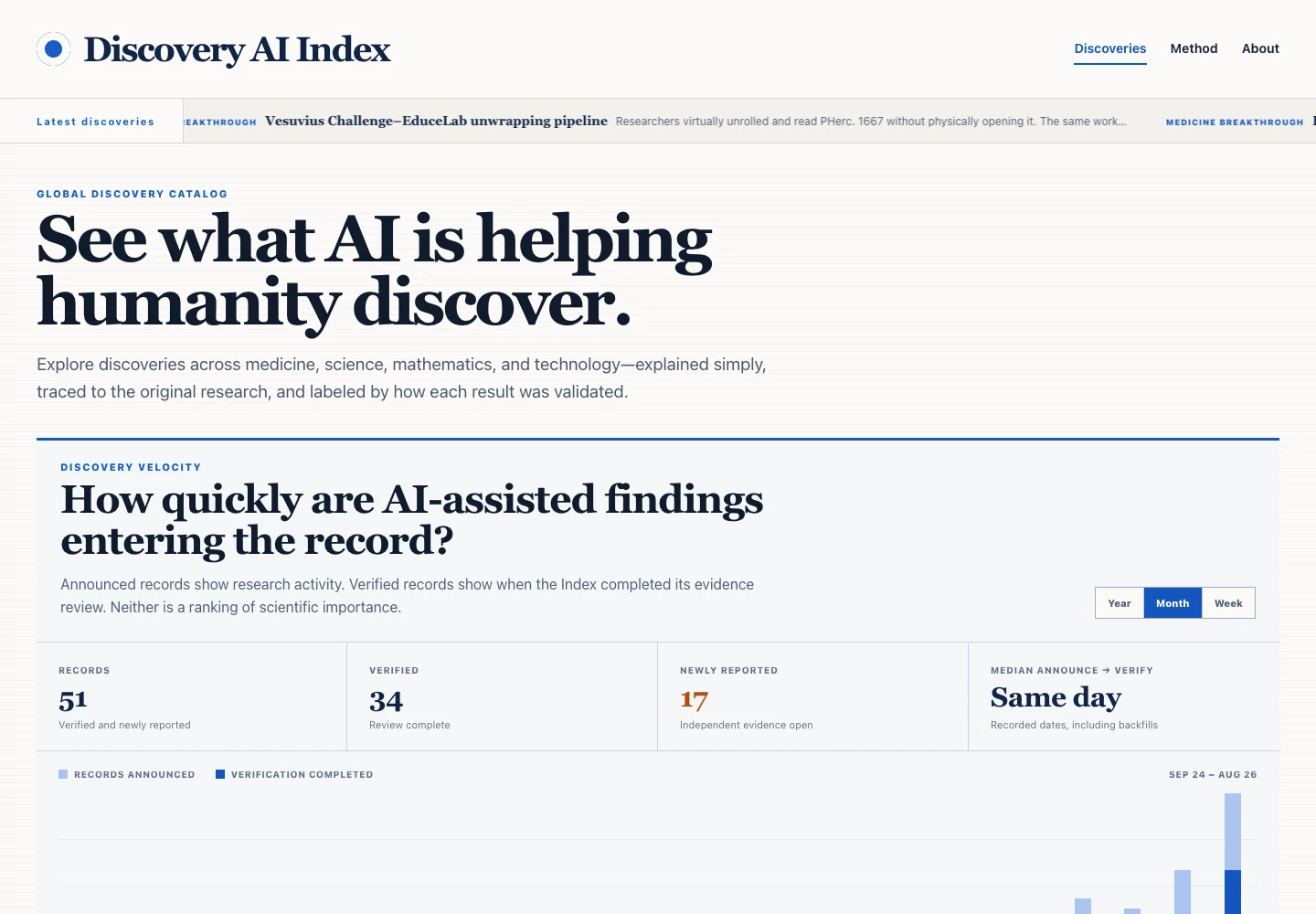
- A clear explanation gives visitors context before they explore the catalog.
- Separate review states help readers distinguish a reported finding from a completed evidence review.
- A dated timeline makes the underlying records easier to explore without treating every discovery as equally significant.
Discovery AI Index is our public catalog of discoveries materially enabled by AI. Building it meant solving a familiar business problem: useful information arrives from many places, but someone needs to organize it, check the evidence and decide what deserves attention.
Our perspective
Automate the collection and organization of information. Give publication its own rules, permissions and review history.
The problem: a feed is not a usable record
A research paper, a news story and a follow-up study can describe the same discovery. Saving all three as separate entries creates clutter. Saving only a headline loses the evidence behind it. We wanted records that explain what changed, why it matters and how AI contributed, with a path back to the source.
This is an independent Arc Labs project, not a client engagement. The public index demonstrates the product; the workflow described here explains the system we built behind it.
See the public project. Explore Discovery AI Index
Four steps from source to publication
We separated intake from editorial decisions so finding a source does not automatically publish a claim.
- Collect: scan a bounded recent window across approved research sources, including arXiv, PubMed and Crossref.
- Organize: check canonical primary-source URLs for duplicates and save new material as private candidate records.
- Assess: review structured records against evidence requirements. A separately authenticated AI assessment workflow uses the same permitted status transitions, with a human editor available to intervene.
- Publish: expose eligible records through the public index and individual discovery pages. Record editorial changes in an append-only history.
The boundaries are part of the build
The source scanner cannot publish records, change the website or rewrite the editorial rules. The assessment workflow can update structured records through a protected interface, but cannot change application code, the database schema or review thresholds. A verified record cannot be silently rewritten through that workflow.
Scan runs have limits and logs. A failed source scan leaves existing public records unchanged. Operators can pause intake while the public index remains available. These are design choices that make a workflow easier to operate and hand over; they do not make every AI judgment correct.
What the finished system contains
The build connects a browser interface, a structured database, source intake, an editorial review interface and crawlable pages for individual discoveries. Information can move through the registry without rebuilding the website for every new record.
- A public catalog with source links and clear publication states.
- A private candidate queue with duplicate checks.
- Separate permissions for intake and editorial updates.
- Run logs, review history and operating instructions.
Inspect the implementation and its stated limits. Read the public source and workflow documentation
Where this pattern could help a business
The same structure could support a supplier watchlist, an industry research desk or a queue of customer requests. The sources and review criteria would change, but the core job is similar: collect information, organize it into consistent records and give someone a clear next decision.
We have not established a time-saving percentage, revenue result or unattended operating history for this project. For a business build, we would first measure the current task, then compare review time, missed items, duplicate records and upkeep after implementation. The useful outcome is a workflow you can understand and operate.
Put this into practice
Let’s talk about your business.
Does useful information get lost across your tools? Tell us what you collect and what someone needs to do with it.
Explore process automation Discuss your project